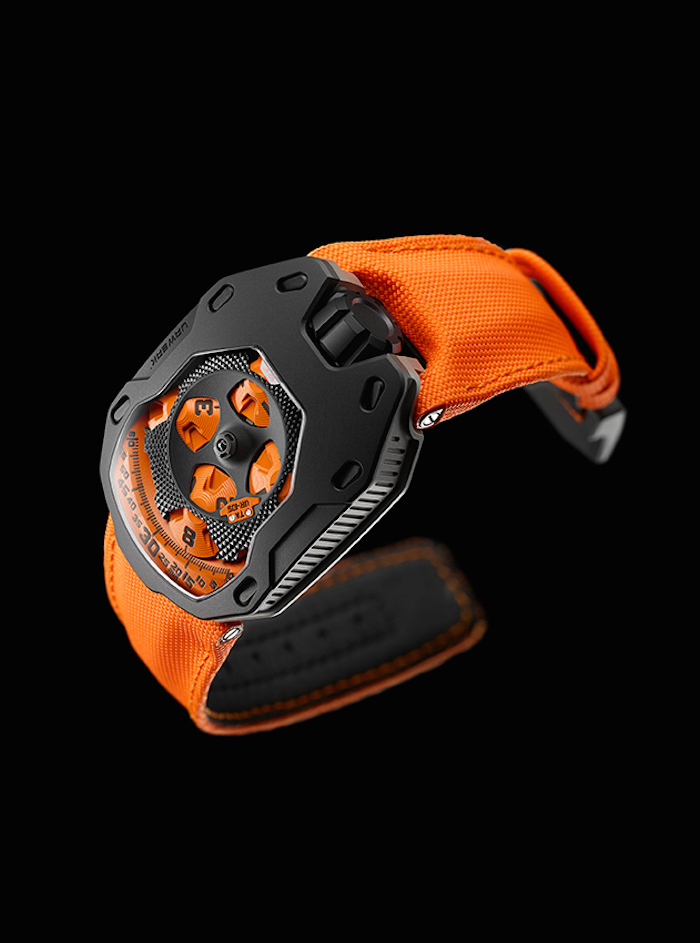
Entering the world of watch nerds, you will inevitably be drawn into the
subculture of strap nerds, those of us who are compelled to change the
straps on our watches. As you might have guessed from previous posts, The Time Bum is most definitely addicted, and quite incapable of leaving the original strap on any watch for very long. The world of watch straps is irresistible because there is such
a wonderful variety of colors, styles, and materials available, and at
prices to suit any budget. A different strap can transform your watch,
bringing out nuances of color and design that might have otherwise gone
unnoticed. Some straps are objects of desire in and of themselves, hand
crafted by artisans and imbued with their own special character. I
confess, I have purchased straps on their own and later bought watches
to go with them, instead of the other way around. Come to think of it,
I've done that a bit more than I'd like to admit.

I
believe we have entered a golden age of watch straps. Niche marketing
and global internet sales have created a booming marketplace. Before
this, most of us kept the factory strap until it wore out, then either
ordered a new one from the watch manufacturer, often outlandish
cost, or we browsed through the rotating displays in our local jewelry
store, found an appropriate brown or black, asked the clerk to find the
right size, and that was it. In retrospect, it was a sad, bleak time
compared to today's abundance. Given this newfound bounty, it can be overwhelming for the watch newbie, but have no fear, The
Time Bum is here to break it down for you. I will post some strap
reviews in the coming weeks, but today I will start by explaining the
common variants of the military style, pass-through strap, or NATO
strap.
There
have been several excellent articles about the history of the military
watch strap in general and the NATO strap in particular. I would suggest
this brief post on Watches by SJX, and then a tour of David Boettcher's Vintage Watch Straps site for a really comprehensive history. Now, I am not a military historian. I am just a guy who buys a lot of watch straps,
and I make no claim to understanding (or caring about) the historical
accuracy of any particular strap design or construction. As a civilian
shopping for straps to suit my mood and style, it is entirely
irrelevant. Rather, what I have for you today is a just basic "what's
what" of the NATO style straps currently on the market, and the jargon
that is typically used to describe them.
Enjoy!
The Time Bum's Guide to Military Style Watch Straps
Pass-Through Strap
Most
likely, 99 per cent of the watches you owned before you became a watch
nerd came on either a bracelet or a two-piece strap. Both of these are
secured between the lugs at either end of the case by spring bars that
travel through the strap or bracelet material, acting as hinges.
Another
type of strap uses a single strip of material that passes over the
spring bars and under the case. For clarity, I will refer to this design
as the "one-piece" or "pass-through" strap. All of the straps below are
variations on the pass-through design. Civilian
straps are generally nylon or leather, and in different hardware
materials and finishes including PVD black, gold finish, and even
bronze. Buckles may be fixed or removable. Length varies but is usually
around 11 inches or 280mm

NATO Strap
The
first thing to wrap your head around is that there is really no such
thing as a "NATO" strap, which is to say, there was never a single watch
strap issued to the NATO forces in Europe. The NATO style strap is a nylon
pass-through strap, with a fixed metal buckle and two metal rings, one
of which is fitted below the buckle end to secure the tail of the strap
after fastening. The other is fixed to a secondary strap through which
the primary strap passes after passing through the bars, and under the
case of the watch. It was first commissioned by the British Ministry of
Defense (MOD) in 1973. It is known as a "NATO" or "G10" because of the way they were cataloged and requisitioned. "NATO" and "NATO G10"
are trademarks of International Watchman, Inc. To my knowledge, this is
a recent development that has nothing to do with the original MOD
contracts. There are very specific criteria that must be met for a MOD
issued strap, but none of them matter for civilian purposes.

Zulu Strap
The word "Zulu" appears to have marketing origins, not military. The CountyComm sales site states "Zulu" is a registered trademark of Maratac, Inc. (see U.S. Patent and Trade Office, "Maratac Zulu"). Regardless, the term is commonly used to describe a pass-through strap made with thicker
strap material and hardware than a NATO style. They usually feature a
fixed buckle and rings that are heavier and more rounded. Some versions
include a secondary strap like the NATO. These straps are also referred to as NATO, Heavy Duty or Extreme NATO, or simply one-piece straps.

3-Ring or 5-Ring
These
terms describe a Zulu or NATO strap by the number of hardware rings it
has. The buckle is counted as a ring as well. A 3-ring has two rings
below the buckle and no secondary strap. A 5-ring has two rings below
the buckle, and two rings on the end of the secondary strap. A 5-ring strap may also be worn with the tail passed back through the upper ring on the secondary strap.
Army or RAF Strap
This
refers to a simple one-piece, pass through strap with a no extra
hardware or secondary strap, and a keeper made from the same material as
the strap, or a metal ring like that on a NATO style strap. This design
was common after WWII, used by the U.S. Military and the Royal Air
Force (RAF).

Bond Strap
This refers to the watch strap worn by Sean Connery in the opening scene of Goldfinger (see my review
of the Seiko SNZF17). It describes a nylon pass-through strap with a
regimental stripe. Opinions differ as to the correct colors, but to my
eye, olive and navy or black with red or burgundy pinstripe appear to be
in the ballpark. The term is often used to describe a regimental stripe
of any color. For the record, Bond could not have possibly worn a NATO
style as it did not exist when the movie was produced.

Bund Strap
"Bund" it refers to the German Bundeswehr, or federal defense forces.
While the strap was adopted by the German military in the 1960's, the
design actually dates back at least to WWI when many pocket watches were
converted to wrist watches for field use. It consists of a strap that
passes through a broad pad that sits under the watch. Sometimes the
strap is a single piece, sometimes it is two pieces secured by tabs,
snaps, rivets, or conventional spring bars. Pad design varies.


 Vedi altro